Most websites don’t fail because of bad products or thin content. They fail because the right people never find them. A business can have a genuinely excellent service, strong reviews, and a clean-looking site, and still rank on page four of Google because its technical and content foundations are weak. That’s the core problem search engine optimization exists to solve.
GOA-TECH works with businesses across industries on exactly this problem. Their team handles everything from technical audits to content strategy to full web design overhauls, and they see the same patterns repeated across almost every client frustrated with their organic traffic. The fundamentals are usually broken in predictable ways. The good news is that predictable problems have predictable solutions.
This guide walks through the full picture, from how search engines work under the hood to the technical signals that most site owners ignore, to the content and off-page factors that actually move rankings.
 How Search Engines Actually Work
Before you start adjusting meta tags or writing new articles, you need a realistic mental image of what you are optimizing for. Google operates on three fundamental processes: crawling, indexing, and ranking. Each one is a possible failure point on its own.
Crawling is where Google discovers the pages on your website in the first place. Googlebot finds pages by following links to and from them. If no one links to a page on your website, or there is no entry for it on your sitemap, then there’s a high chance it will never get discovered by Googlebot. This might seem obvious at first glance, but crawl issues are a very common reason pages disappear from Google after a site migration or restructuring. It still exists, but Google stops finding it, so it won’t appear in search results.
Indexing comes next. After Googlebot visits a page, Google parses its content, stores it in its Index (a giant database that it refers to when people use Google to search for something), and then makes it available for ranking. Not all crawled pages get indexed, and Google doesn’t pick pages at random. Sometimes it skips over a lot of pages because it finds them low-quality, duplicates, or not valuable enough to bother with. Google Search Console shows which pages have and haven’t been indexed, along with the reason why.
Then comes the ranking. After a page has been indexed, its ranking depends on the algorithms and the factors they consider. It might rank in position 1 for some searches, but not for others. They assess dozens of different signals: relevance to the query, the number of high-quality websites that link to the page, the page’s load time, its mobile friendliness, its content quality, its structured data, and a whole lot more. SEO is simply about making sure your website sends the right signals so it can appear in search results when users are looking for answers.
The Technical SEO Foundation You Can’t Skip
Technical SEO issues are invisible; they don’t announce themselves, but they slowly drain your traffic. Your content is only as strong as the technical setup behind it. Here are the key elements:
Crawlability and indexation. Your robots.txt and meta robots tag tell search bots what they are and aren’t allowed to crawl and index, and these are often misused in situations such as CMS updates or theme changes. A common example would be an accidental ‘noindex’ on a category that then removes a lot of pages from the Index. This should be checked regularly in the Coverage report in Google Search Console to prevent issues.
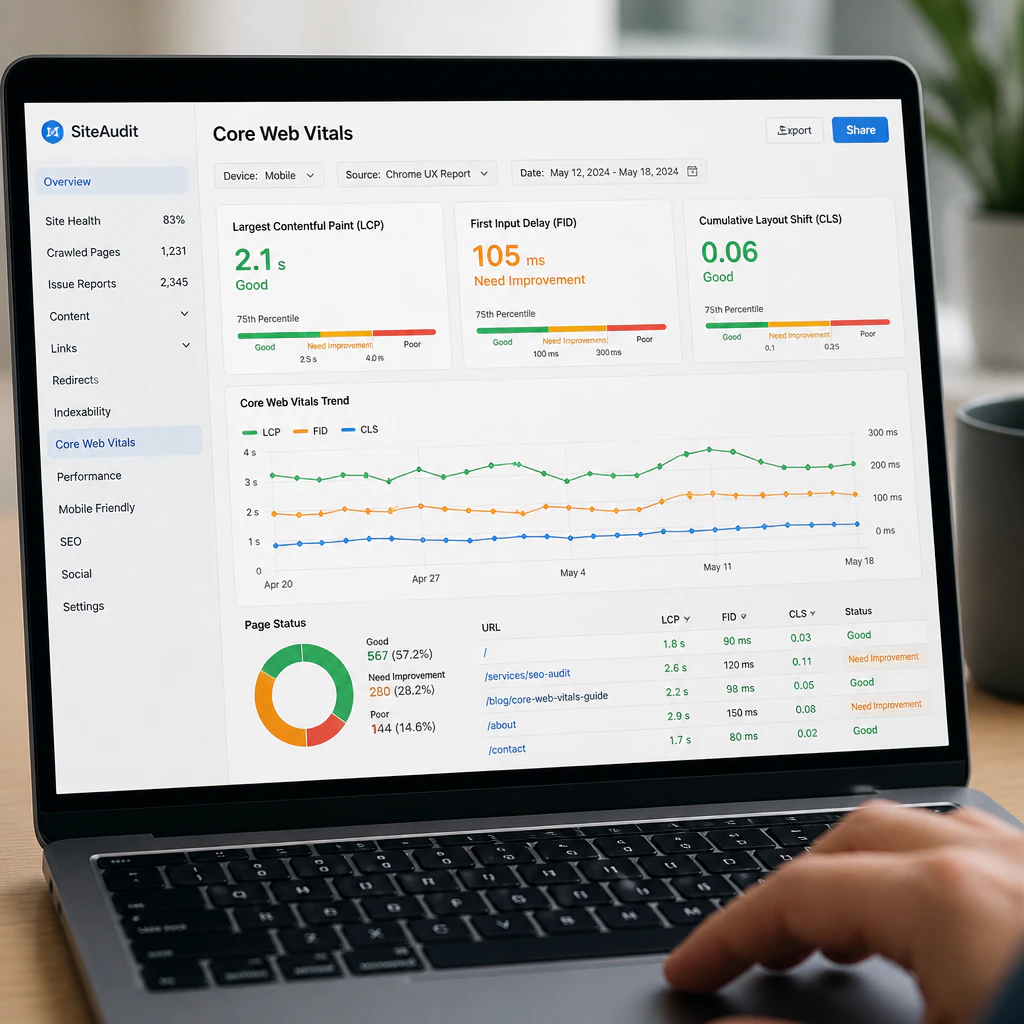
Site speed. Google first introduced page speed as a ranking factor in 2010 (desktop), expanded it to mobile in 2018, and later incorporated Core Web Vitals as a formal ranking signal in 2021. Core Web Vitals evaluate real-world user experience factors such as load time, visual stability, and responsiveness. Common performance killers include sluggish hosting, unoptimized images, render-blocking scripts, and excessive third-party code. Addressing these issues generally involves upgrading hosting plans, compressing media files, and streamlining the codebase.
Mobile friendliness. Google primarily crawls and indexes the mobile version of a site, not the desktop one. If mobile users have a poor or confusing experience on your site, your search performance will suffer even if the desktop site is polished. Use Google’s Mobile-Friendly Test tool alongside the Mobile Usability report in Search Console to identify and resolve issues.
Structured data. Implementing schema markup helps search engines understand and categorize your content, whether it’s a product, recipe, organization, or frequently asked questions section. While schema doesn’t directly influence rankings, it often enables search results to display enhanced features (rich snippets) such as star ratings, pricing, and event specifics, which can significantly boost click-through rates. Validate your implementation with Google’s Rich Results Test and the Enhancement reports in Search Console.
HTTPS. Google has officially recognized HTTPS as a ranking signal. If your site is still served over HTTP or triggers mixed-content security alerts, make HTTPS a priority now rather than deferring it.
XML sitemaps. An accurate, up-to-date XML sitemap communicates to search engines which pages are available, how often they’re updated, and their relationship to other pages. Upload your sitemap to Google Search Console and ensure it remains synchronized with your site’s content.
On-Page SEO Optimization for Better Rankings
Optimizing the pages on your website involves optimizing the visible page content, page markup, and meta-tags in ways that are meaningful for users as well as the search engine spiders.
Page titles and descriptions. The page title tag is still a strong signal within your direct influence that you can leverage for SEO success. Include the main keyword in a natural way and try to keep the length under 60 characters. Search snippets will usually truncate text longer than this. The meta description is not a strong ranking factor, but it does influence click-through rates. It’s a free opportunity to entice search users. Many companies forget to write their description at all.
Heading tags. Every page should contain just one H1 heading, summarizing the primary theme for that page. H2s and H3s structure content so readers understand the layout and give search engines a good sense of the overall scope. Because search engines attribute more semantic meaning to headings, it’s important to include related keywords within H2s.
Content depth and search intent: Google’s objective is to align pages with what a user really wants rather than just matching the terms they used. Thus, keywords and search intent are equally important. A page targeting a comparison query should contain a comparison; a query that’s a “how to” should contain steps the user can take. If the content doesn’t provide what’s needed to answer the query, the page isn’t likely to perform well in search results, no matter how well it otherwise handles on-page optimization.
Internal linking: Every newly published page should be linked to and from other appropriate pages within the site. Internal links provide an opportunity for search engines to discover content, distribute authority, and gain insight into how pages relate to each other. They’re also one of the most underused strategies site owners can implement today. Internal links are also how Google discovers orphan pages—pages that no other part of your site links to.
Image optimization: All of these contribute to SEO: descriptive file names, alt text that truly reflects what the image is about, and compressed file sizes. Alt text, in particular, helps search engines understand images and makes the page more accessible.
Off-Page SEO and Why Authority Still Matters
Off-page SEO encompasses all of the factors that affect a website’s authority and credibility from outside the website itself. Backlinks remain one of the most significant of those factors, alongside content quality and user behavior signals that Google has emphasized more in recent years.
When another site links to yours, it’s a recommendation. Google’s original PageRank algorithm worked on the premise that backlinks represent the number of recommendations a page has received. The algorithm has since evolved beyond that concept, but the core idea remains valid: the greater the number and quality of links that authoritative, relevant sites offer to your content, the higher your content will perform in search rankings compared with other pages that don’t have as many links or have lower-quality links.
“High-quality” is doing a lot of work in that statement. The value of a handful of links from appropriate, authoritative sites is greater than that of hundreds of links from low-quality directories or link farms. Plus, trying to manipulate this process (e.g., buying links, participating in large-scale link exchanges, or building fake link farms to boost authority) can result in penalties that push a website’s ranking well off the first page.
The best way to generate backlinks is to earn them by creating worthy linkable assets like original research, guides and how-tos, free tools, useful data, and credible analysis over time. Other ways to get links include press mentions, partnership announcements, and guest articles in reputable industry publications. It isn’t quite as efficient as buying links, but that is how backlinks work. It’s the only approach that works over time.
For local businesses, brand mentions, social signals, and citations form the rest of the off-page puzzle. They aren’t nearly as influential as links, but they do help Google build an overall authority rating for your domain.
SEO Content: Writing for Humans in a Search Engine Friendly Way
The more accurate goal is: ‘write for humans in a way that’s also search-engine friendly.
When it comes to content, SEO means knowing what the search intent is behind the search terms being used. The intent for a search like “technical SEO” is likely very different from the intent for a search like “technical SEO Miami.” One user wants an answer, one wants a solution. A page optimized for the term “what is technical seo” is designed to educate. A page optimized for “best technical SEO agency in Miami” is designed to persuade.
Content quality signals Google has continued to strengthen over the years include things like unique content (original analysis or perspective rather than a slightly rewritten version of what’s already on a dozen other sites), true depth of coverage, factual accuracy, authoritativeness of author and domain, and other trust signals like domain age and social authority.
Google’s Search Quality Rater Guidelines introduce a framework called E-E-A-T: Experience, Expertise, Authoritativeness, and Trustworthiness. These concepts are meant to define what Google raters should be assessing when they look at your content quality.
In practice, that means creating pages with the following things in mind:
- Actually answer the questions people came to your page to ask, and cover the topic thoroughly. Thorough is not the same as long. Add length only when it adds something the reader needs.
- Link out to sources to back up any claim you can. Fabricated numbers or statistics and vague statements like “the top SEO company” without any proof can damage trust in a way you cannot recover from. It’s better to not make the claim at all than to make it and have no proof.
- Update content when time has passed. Especially for topics that change fast (i.e., SEO), it really hurts the trust in a piece of content if it hasn’t been updated for several years.
- Try to provide credibility for the author within the piece. This can take the form of linking to them on other published pages, showing the author’s credentials, having them provide a bio of who they are, etc.
At GOA-TECH, we combine SEO keyword research, content and competitive analysis, and editorial judgment to determine which keywords to target. That combination is what produces durable, high-quality SEO content.
Using Google Search Console and Google Analytics to Make Actual Decisions
It doesn’t make sense to improve the SEO of a page or to optimize your SEO for better results in search engines without knowing how it’s actually performing. Fortunately, these two free tools are available to every website owner to use for tracking and analysis.
Google Search Console (https://search.google.com/search-console/about) tells you exactly what you rank for in Google Search, your average position for each search term and query, what search queries and pages are getting impressions and clicks, and other important technical information about your site like how many URLs were crawled in a time period, and whether any errors were found by Google bots. The Performance report is great for identifying your “keyword gap,” the pages that are ranked 11th to 20th (i.e., page 2 or 3). These pages will probably be the ones that can benefit the most from focused optimization. In fact, that may be where you’ll find the biggest potential ROI.
On the other hand, GA tracks how users behave once they arrive on a page. How long are they on-site? What actions do they take? Where are they leaving from, or did they convert? Combining GSC data with Google Analytics gives you insight into whether you have successfully attracted the right audience and if your website is performing well enough to retain them.
Both tools are completely free to use, and using them together is crucial for prioritizing your efforts over the long run instead of trying to optimize for everything at once.
Common SEO Issues Found in Technical Audits
An SEO audit is a comprehensive examination of the on-site and off-site aspects of a business website that can impact its ability to rank in SERPs. Some of the most common issues that arise from audit reports include:
Duplicate content. Search engines need to know which version of your content to index. This becomes an issue when you have identical content available through various URLs such as duplicate URLs with query strings, duplicate content due to www and non-www or http and https versions, and duplicate content caused by pagination issues. You can avoid duplicate content penalties by adding canonical tags that indicate which content is the preferred version to index.
Broken links and redirect chains. You’ll lose valuable crawl budget every time Googlebot encounters a 404 error. In addition, redirect chains (i.e., redirecting URL A to URL B, and URL B to URL C) dilute ranking power and increase the load time of your website. You should identify redirect chains and broken links during your audit and resolve them by applying clean 301 redirects.
Thin or low-value pages. Low-quality pages such as auto-generated content, thin tag archive pages, or content that’s only accessible through pagination can affect how your website is perceived by search engines. You can resolve these issues by removing these low-quality pages or consolidating them.
GOA-TECH identifies these issues systematically, whether through an isolated audit service or as part of our overall SEO campaign services. The simple fact is that an SEO audit that gets results and gets things fixed, as opposed to one that gets ignored and sits in a binder, should provide a clear, prioritized list of things to fix.
What Local SEO Is and Why It Matters for Miami Businesses
Local SEO is a unique set of considerations in addition to all of the factors mentioned above when targeting a specific service area like Miami or South Florida.
For local search on Google, the most important factors are the presence of a Google Business Profile listing, the proximity of the physical business, and the uniformity of business name/address/phone (NAP) information. A business that has an incomplete or inconsistent GBP listing will have to compete with businesses that have optimized their profile, potentially without any knowledge of it.
Local citations—accurate listings on platforms like Yelp, the Better Business Bureau, and other industry directories—help validate business information across the web and strengthen local SEO signals.
Finally, Google reviews are a ranking signal for local SEO and also help with consumer conversions for searchers who are looking for a business.
For businesses that may serve Miami-Dade County as a whole, combining a local SEO strategy with the technical SEO and content strategies described in this article creates a foundation for sustained search visibility. Neither strategy on its own will be effective enough to make it in a highly competitive market like Miami.
 Website Optimization SEO: Where It All Comes Together
Many SEO campaigns fall flat because they are only partially executed. For example, a website may have its title tags optimized, but it never builds backlinks. Or it has a large amount of content created that the search engines can’t crawl because of technical issues. Or it has good on-page organic SEO but ignores local SEO in a business that needs to rely on local search to convert visitors into customers.
For effective website ranking, the most impactful SEO approach is to consider all aspects of an SEO project as part of the same ecosystem. Technical SEO is what gets the site up and running at Google’s standard, with fast loading times, proper site structure to enable crawling, mobile friendliness, and error resolution. On-page SEO ensures each page is optimized for the target keyword or search intent it needs to rank for. Content creation produces what users actually want to find on a website. Off-page SEO efforts, like link building, establish the authority and trust of a domain so it stands out against other, higher-ranking sites.
Monitoring your progress with tools like Google Search Console and Google Analytics, and using SEO audits on a regular basis, closes the loop of SEO work to understand what’s working and what’s not, and what your next step is to get ahead.
At GOA-TECH, we’ve helped Miami companies and many others throughout the state do all of the above, and more. Whether it’s a startup website trying to establish a foothold online, or an established business struggling with the impact of an algorithm update or botched site migration, we provide a comprehensive consultation to see where a website actually stands and what needs to happen to move the needle. You can check our SEO packages, and see what it looks like to take an SEO campaign seriously and build a sustainable search marketing strategy.