Most business owners know they need SEO. But only a few understand what that actually means in practice. It’s not a switch you flip or a box you check. It’s a system, and when that system works, your pages start showing up where your customers are already looking.
This guide walks through the core elements that determine where your site lands in search results, from the technical foundation to the content strategy that keeps you there. Whether you’re starting from scratch or trying to figure out why your rankings have stalled, the principles here apply to almost any site in any industry.
GOA-TECH is a Miami-based digital marketing agency offering SEO, web design, social media, advertising, and IT services. The team works with clients across industries, and their approach to optimization is built around what actually moves rankings. This article draws on that same framework.
 The Purpose of Search Engines
One often overlooked aspect of SEO is understanding what search engines are actually trying to achieve.
Their purpose is simple: deliver the most relevant, trusted, and authoritative results for a given search. Everything else follows from that. If your page genuinely answers the query, is technically accessible, and is treated as a valuable source by other reputable sites, you rank.
Search engines use software programs called bots (also known as crawlers or spiders) to crawl the web, index the pages, read the content of those pages, analyze the structure, and update the index. So in essence, working on SEO simply makes this process easier while signaling that your content is genuinely valuable to readers.
Technical SEO: Keeping Your Site in Order
Technical SEO can seem like a dry subject, and there’s not a great deal of hype surrounding it, but it’s also the place where rankings are quietly lost at an alarming rate. Even the most helpful content can still rank poorly if the website it’s hosted on is slow or difficult to crawl, or if there are technical issues that haven’t been addressed yet.
Here are a few good places to start.
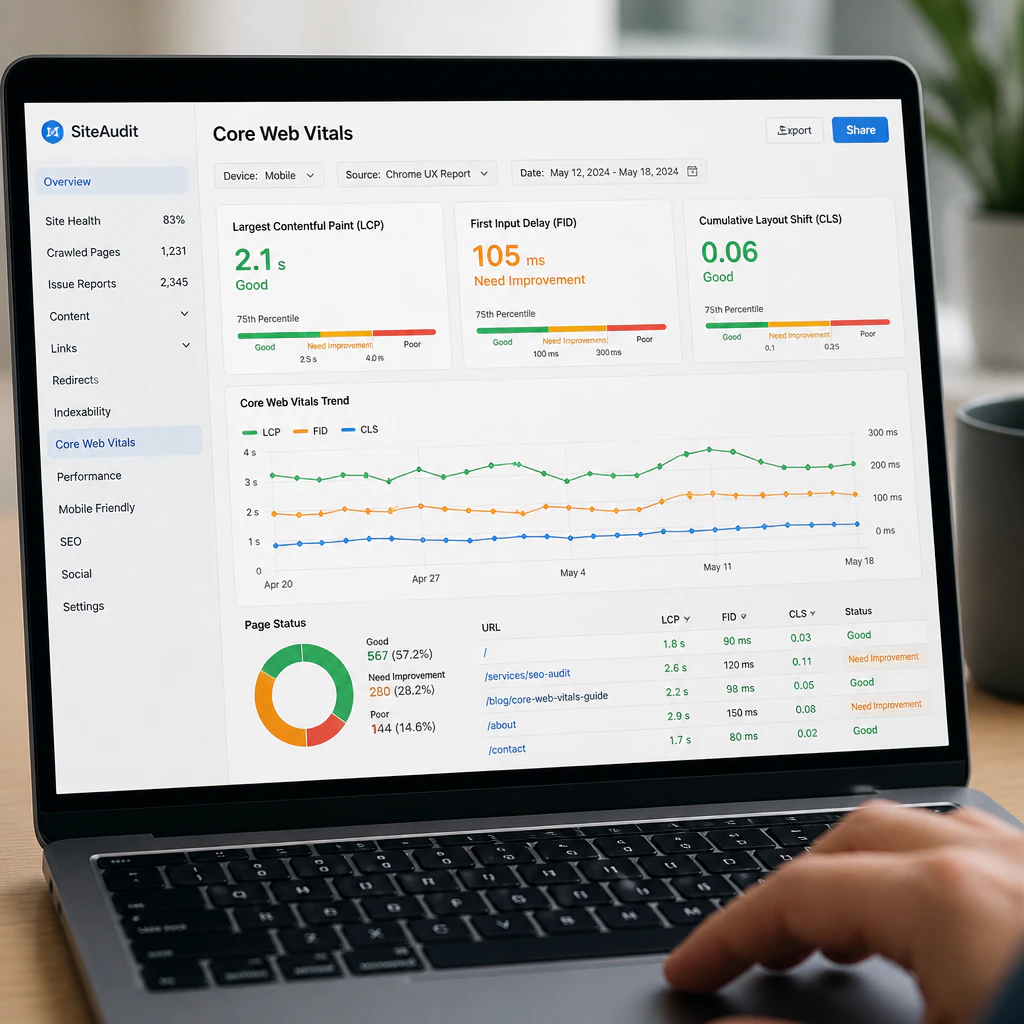
Site speed. Google uses page speed as a ranking factor, and users bounce from slow web pages quickly. Google’s own PageSpeed Insights tool is a good place to start. It will give you a score and show you exactly what’s slowing things down, such as unoptimized images, excess JavaScript, or slow server response times.
Mobile devices. Google indexes the mobile version of a site first. So if your site is great on desktop but poorly suited to mobile, Google will rank you lower based on your mobile performance. You should be testing your site on actual devices rather than emulating a mobile screen with your browser.
Crawlability. If a crawler cannot reach a page, it will not index it. Check your robots.txt file to make sure you aren’t blocking search engines from accessing certain chunks of your site. You should also make sure you have not generated orphan pages that aren’t connected to any other site pages.
Broken links. Broken links are frustrating for users and represent an inefficient use of a crawler’s crawl budget. Check for and fix any broken links on your website, or redirect them to relevant content on your site.
Duplicate content. When the same pages appear on multiple different URLs, Google might not know which page it should rank higher than the others. It helps to mark a canonical tag on the page you do want to rank, signaling that one URL is the preferred version.
Structure. Keep your site’s URL hierarchy simple and descriptive. A URL like “/technical-seo-guide/” is far clearer to both Google and your customers than something like “/page?id=2847&cat=3.
Tracking Your Site with Google Search Console
Google Search Console is a free service that lets you see the world from Google’s point of view. It tells you which searches your site shows up for, how often that happens, what your click-through rate looks like, and flags any crawl errors it ran into while indexing your site.” Google Search Console is a must if you plan to track your progress.
Submit your sitemap to Google Search Console after verifying your domain. This doesn’t mean your site will be indexed, but it will assist crawlers with getting your site indexed faster. More useful than that, however, is the ability to see which pages Google has indexed and why it hasn’t indexed some of your pages.
The Importance of Keyword Research in Search Engine Optimization
You want to rank for terms that match what’s on your page and that actually bring in useful leads—not just any traffic. Finding keywords, simply put, is finding the language and phrases your audience uses to look for what you have to offer.
Start with one phrase that describes what you offer, using as many words as it takes to be clear. In the hour before a customer picks up the phone to call you, what did they type into Google?
Now, find more words that have a similar intent but are not exactly the same phrase. The intent of someone searching for “affordable SEO packages” and “SEO pricing in Miami” is the same, but they use completely different language to express it. You can target both naturally in your content rather than forcing one rigid phrase onto the page.
Here are some tips to think about when doing keyword research:
- Just because a term has higher search volume doesn’t mean it’s a good keyword to try and rank for. Sometimes a lower-volume term brings in more leads because it carries clearer intent, while broad terms tend to be vague.
- Long-tail keywords (three or more words) usually are easier to rank for, and the person searching them usually has much stronger intent.
- Don’t be afraid to analyze what ranks #1-10 for the terms you’re looking at. Maybe you’ll notice that the top results are all from large, trusted publications with thousands of backlinks. If so, try finding a different keyword.
GOA-TECH’s SEO Services include keyword research, but it’s important to understand that it is just one piece of the puzzle. If you are looking to rank for just one keyword without any thought on how you’re going to achieve your end goal with content marketing, you’re likely in over your head.
 On-Page Optimization Tips
On-page optimization is where keyword research is applied to your content in the real world. It’s all about giving both the user and Google a clear picture of what you’re providing on that one page.
Headings. Your H1 header should include your target keyword exactly once on each page. Use H2 and H3 headers to break up the content beneath it and, where it makes sense, work in relevant terms. An organized and solid heading hierarchy also makes it easier for site users to scan the page and stay engaged with the material.
Meta descriptions. Meta descriptions don’t directly impact your search rankings, but they can definitely affect your CTR, which matters. A well-crafted meta description, which should be less than 160 characters, lets the reader know what they can expect from your page and provides a compelling reason for them to select your SERP listing over any other.
Optimized images. Every image on a page should have an alt tag describing its content. Image alt tags assist visually impaired site visitors, while also signaling what’s in the image to crawlers. Also, optimize images by reducing their size before uploading them to a webpage. A 4MB image on a blog post will drag your page speed down.
Internal links. Linking between the pages on your site helps share and pass authority and can help crawlers find content they may not have otherwise discovered. Whenever you publish new content, seek out two or three other existing pages on your website that would be natural places to contextualize the newly released material.
Website Optimization Involves Content That Ranks in Search Results
Search engines don’t rank domains; they rank individual web pages. What ranks, again and again, is the content that best provides the answer to a user’s question relative to every other result they see.
This sounds straightforward. It is more complicated than that, though, because “best” will depend on the intent of the searcher. “Best” can mean providing more comprehensive coverage for some searches. For other queries, the “best” result will provide greater specificity. For searches that contain a geo-modifier, a “better” result will be one with a geographic focus. Understanding search intent—what the user is actually trying to accomplish—is what separates content that ranks from content that doesn’t.
A few additional tips include:
Match the format of results users see now. When almost every result for a given query is a how-to guide, publishing a long narrative probably won’t be a good strategy. Match the format first, and then work on depth or angle.
Freshness is critical in some industries and unnecessary in others. A post that explains SEO fundamentals will rarely need updating. One that analyzes shifts in Google’s search ranking guidelines definitely will. Know where the content falls along the spectrum of freshness and act accordingly.
Avoid thin pages. Thin content, that is, any page that isn’t robust and full of value, has difficulty achieving any search rankings. A site page that doesn’t have an independent and valid reason for existing should either be consolidated or dropped from the site.
Building Quality Backlinks and Links
A backlink is simply a link on another website that points back to yours. Search engines consider these backlinks as “votes of confidence.” When a reputable, industry-relevant site links to yours, it signals to Google that your page contains valuable, referable content. Google has consistently said that the quality and relevance of linking sites matter more than raw backlink counts. A handful of editorial links from authoritative, topically relevant sites will outperform hundreds of links from low-quality directories.
This is where much of the SEO advice you’ll find online turns genuinely harmful. It is entirely possible for Google to penalize you for buying backlinks or participating in link schemes, such as gathering thousands of links from unrelated, obscure directories. These shortcuts can result in a drop in rankings, so the long-term strategies that actually stick are the ones you should follow:
- Create valuable content that other websites within your vertical will want to share. Content like data reports, new research, and detailed tutorials can build natural backlinks over time by simply being useful.
- Form personal relationships with other business owners, non-profits, and media outlets in your field. For example, a backlink from a Miami Chamber of Commerce website will hold far more weight than one from an online link directory.
- Guest posts on industry-related sites can be an excellent way to build high-quality backlinks if the content you write is actually useful, rather than simply a thinly veiled attempt to slip in a link to your company website.
Improve Your SEO Performance Over Time
Google rankings change. It’s typical to have a web page jump to the #1 spot two weeks after optimization only for it to drop back down to the third search results page several weeks later, either as your competitors update their content or Google tweaks its ranking factors in the background. That’s a standard outcome. You should be focused on tracking your performance trends, not specific rankings you see on one particular Tuesday morning.
Monitor a few key metrics on a regular basis. Organic traffic (meaning visits without paid advertising) is your best indicator of whether SEO is working. Look at the average position reported in Google Search Console to see how well you’re ranking for target search terms, and pay attention to click-through rate—how often people actually click your link when it appears in results.
Reviewing these stats every month is plenty; more frequent review will only cause stress, and you won’t be able to make meaningful changes based on the results. Quarterly is the right rhythm for making larger adjustments, whether that’s building new content for a topic you want to cover, or doubling down on an underperforming page that you’re trying to improve.
None of these pieces work in isolation. Technical health, keyword research, on-page optimization, content quality, backlinks, and consistent tracking are all part of the same system, which is why the strongest SEO results come from working on them together rather than one at a time.
For a one-on-one conversation with GOA-TECH to help you determine the best SEO strategy for your site, contact us for a consultation. We can provide practical, actionable ideas about which areas to prioritize.