Most business owners know they need SEO. What they often don’t realize is how much of it lives under the hood, in code, server configurations, and crawl logic that never shows up in a blog post or social caption. That’s where things tend to break down quietly, and where rankings plateau for reasons that aren’t obvious from the surface.
A skilled technical SEO specialist closes that gap. Not just by writing optimized content or chasing backlinks, but by diagnosing the technical infrastructure holding a site back and fixing it systematically.
At GOA-TECH, based in Miami, that kind of work is core to how the team approaches search engine optimization for clients across industries.
 What Technical SEO Includes
People often think of SEO as keywords and content—and both matter. But it’s the technical layer underneath that lets search engines see, crawl, and index your pages in the first place.
Even if you have the best content on the web, that content can’t rank if a search engine can’t get to it. So technical SEO covers things like site speed, URL structure, mobile-friendliness, schema markup, internal linking, sitemaps, and canonical tags—elements visitors never see but that crawlers rely on as they move through your site.
Google has been direct about this: a site needs to be easy for search engines to crawl and index before it has any real chance of ranking well. All other types of SEO, including content and link building, are built on top of a solid technical foundation.
The Technical SEO Specialist Role: A Day on the Job
While there is obviously a degree of variety depending on who you are and where you work, a typical day in the life of a technical SEO specialist includes auditing websites to find technical problems, prioritizing those problems, and fixing them.
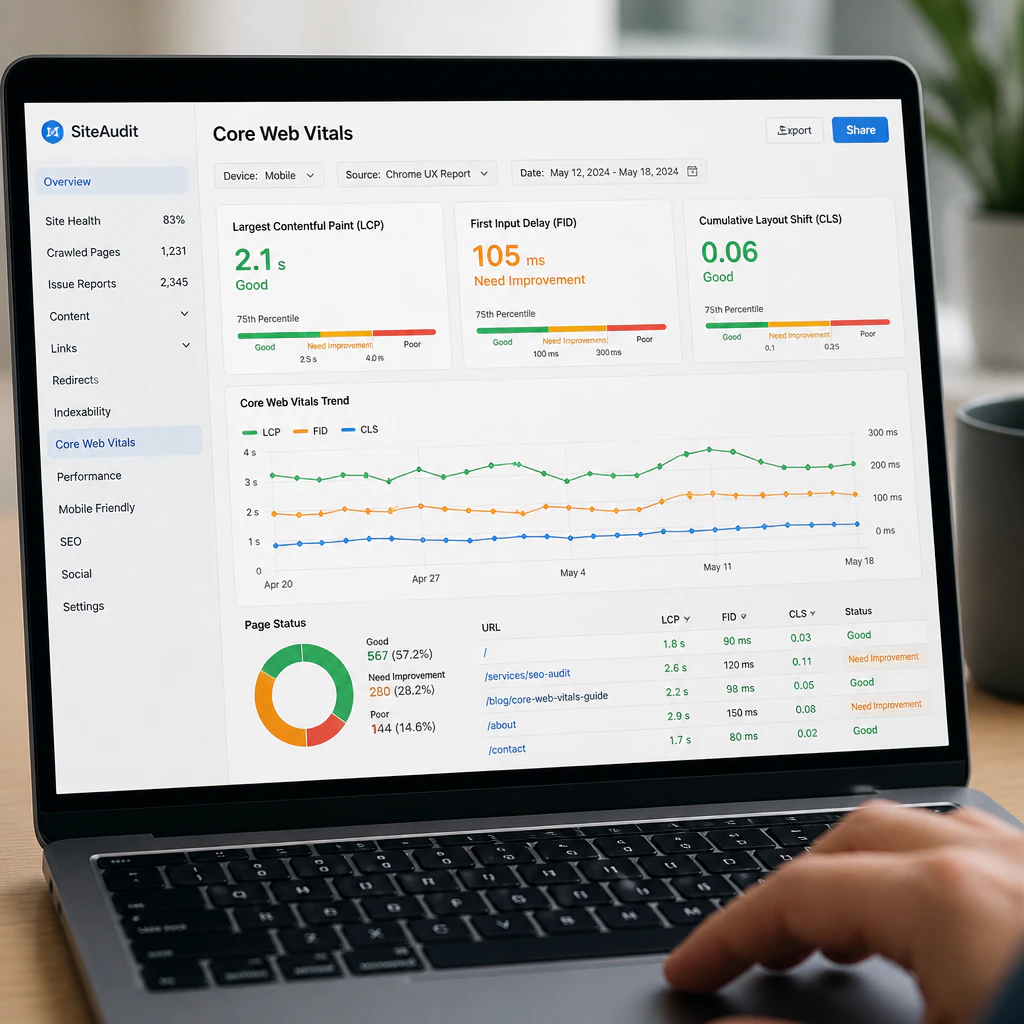
One day might involve running a crawl in a tool like Semrush to catch broken links or messy redirects. Another might mean digging into Google Search Console to see why a ranking page gets little traffic, checking Core Web Vitals to find the JavaScript or CSS behind a slow load, or reviewing a section of the site to confirm every title tag and meta description is in place. Tools change from client to client, with options such as Screaming Frog, Google Analytics, Yoast, or even HubSpot showing up in GOA-TECH’s tech stack. What doesn’t change is the mindset: examining how a site runs from the ground up to find the technical issues dragging down its rankings. These are exactly the audits GOA-TECH runs—the technical layers most firms don’t spend enough time on.
How One Technical SEO Issue Can Tank Your Rankings
What a lot of business owners don’t realize is that it doesn’t take many technical problems to drag a site down. A single one, on its own, can be enough to lower your rankings.
Take site speed as an example. Google now uses Core Web Vitals as a ranking factor, which means a slow site can result in lower rankings. According to Think with Google, if the speed of an e-commerce page slows down by one second, it can reduce conversions by up to seven percent, which makes this a revenue problem as much as an SEO one.
Broken links mean your crawlers can’t find certain pages. Duplicate pages mean you don’t know which page is going to get the ranking boost. If you aren’t using canonical tags properly, you’re splitting up ranking credit. If you don’t use schema markup, you might be losing out on rich results in the search engine results page. A page might just be buried too deep in your URL structure so the crawler treats it as low priority and doesn’t give it much attention.
This isn’t necessarily the most exciting part of SEO, but the more consistent you are at fixing technical issues, the better your rankings should be, and the faster you should see that improvement.
What a Technical SEO Audit Actually Covers
This is why an SEO audit is almost always a place to start. Not your 20-minute generic checklist, but a real look at how a site is actually performing in interaction with search engines.
A full SEO audit works through questions like these: Can Googlebot crawl your site? Are the right pages indexed and the wrong ones blocked? Are your titles, meta descriptions, and header tags set up properly? How does the site perform on speed and Core Web Vitals? How well does it rank on mobile? Is your internal linking sound, and how healthy is your backlink profile?
At the end of the audit, you receive a list of priorities based on which fixes would have the greatest impact on your ranking. Some fixes are easy to implement in minutes, like editing meta descriptions or fixing broken redirects. Others will need the support of a developer, for instance optimizing server response time or redesigning URL structure. A skilled technical SEO specialist can make these distinctions and translate technical jargon into actionable advice for developers.
Keyword Research: A Technical SEO Skill
Technical SEO and keyword research go hand-in-hand.
When planning site architecture, you’re also considering how keyword intent maps into site structure. Should a given term live on a landing page or a blog post? Are two pages competing for the same term when the ranking signals should be consolidated on one? Does your internal linking build topical authority, or is it just a loose collection of pages?
Keyword research, done properly, doesn’t just give you a list of keywords you need to target but shows you how to restructure your site so that every piece of content on it has a clear purpose to search engines and people.
Hiring an SEO Specialist: Career Path and Experience Levels
Regardless of whether you are looking for in-house talent or an SEO agency, it is useful to understand what each level of experience means.
A junior SEO should at least be able to do basic on-page SEO audits. A senior SEO specialist should be able to run an audit on the whole site, design a site structure, and connect results to business outcomes.
Strong talent knows HTML and CSS, understands how server configuration shapes what Googlebot sees, and is comfortable with Search Console and at least one crawler platform. They grasp how link signals interact with technical SEO rather than treating SEO as purely on-page or off-page work—and they can explain all of it in plain language to someone who’s never touched these tools.
 Working with GOA-TECH’s Technical SEO Experts
GOA-TECH built its SEO practice on the philosophy that if technical SEO is lacking, a site will not be able to rank, and the team in Miami follows this approach on every engagement.
GOA-TECH starts engagements with an SEO audit and site structure review, then works with developers to implement changes, followed by ongoing performance monitoring. This is not a throw-it-over-the-wall service.
Companies that have been publishing content regularly but can’t seem to climb the rankings will see significant improvement when a technical audit is performed. For new websites, a sound technical foundation from day one means every piece of content performs better than it would on a site where publishing came before the technical work.
If your website is not performing as well as it should be, it’s worth speaking to someone from GOA-TECH about your SEO challenges. The problem is almost always findable. And more often than not, it is technical.